Protein content in coffee.


In coffee, free and bound proteins account for roughly 10 to 13% of coffee dry matter in both arabica and robusta coffee1, 2. The actual amino acid concentration is highly dependent upon the level of maturation with levels of tryptophan, threonine, glycine, tyronine, serine, alanine, lysine and arginine increasing with further ripening3.

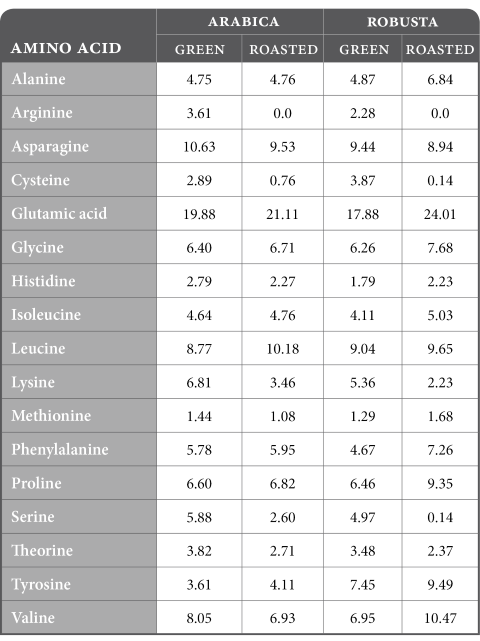
Likewise, storage of green coffee at elevated temperatures increase the concentration of several amino acids due to proteolysis and non-enzymatic reactions4. Table 1 illustrates amino acid concentration for both arabica and robusta coffee.

Table 1a: Amino acid composition of coffee (%)
 Arabica
Robusta
Amino Acid
Green
Roasted
Green
Roasted
Alanine
4.75
4.76
4.87
6.84
Arginine3.61
0.0
2.28
0.0
Asparagine
10.63
9.53
9.44
8.94
Cysteine
2.89
0.76
3.87
0.14
Glutamic acid
19.88
21.11
17.88
24.01
Glycine
6.40
6.71
6.26
7.68
Histidine
2.79
2.27
1.79
2.23
Isoleucine
4.64
4.764.11
5.03
Leucine
8.77
10.189.04
9.65
Lysine
6.81
3.465.36
2.23
Methionine
1.44
1.08
1.29
1.68
Phenylalanine5.78
5.95
4.67
7.26
Proline
6.60
6.82
6.46
9.35
Serine
5.88
2.60
4.97
0.14
Theorine
3.82
2.71
3.48
2.37
Tyrosine3.61
4.11
7.45
9.49
Valine
8.05
6.93
6.95
10.47
a:Parliment, T.Chemtech, 1995

During roasting amino acids play a critical role in the development of color, aroma and flavor compound via the Maillard reaction5. Although most of the amino acids react to some extent - it is those amino acids polar in nature (ie. those containing -SH, -OH, and -NH2 side chains) that react more readily with carbohydrates to produce important flavor compounds.

According to a 2002 study by Swedish scientists, coffee along with several hundred other thermally process foods maybe a source of "acrylamide" - a probable carcinogen formed during the Maillard reaction. As such,  its been suggested that the amino acid "asparagine", commonly found coffee,  may be a involved in the formation of this compound. 

Suprisingly, it has been documented that less than 10% of coffee's bitter actually come from caffeine, but rather from the  compounds produced during the Maillard reaction.

References:
1.Petracco, M. Our Everyday Cup of Coffee: The Chemistry behind its magic (pdf)
2. Parliment, T. What Makes the Coffee Smell so Good. CHEMTECH
3. Illy, A. Espresso Coffee, 1st Ed.
4. Illy, A. Espresso Coffee, 2nd Ed
5. Clarke, M. Recent Advaces in Coffee.